PLACE: Patch-Level Agnostic Concept Extraction
- 1 Northeastern University
- 2 Sapienza University of Rome
- 3 Syracuse University
NeurIPS 2026
Show

Concept
Abstract
While Vision Foundation Models (VFMs) are increasingly used in several computer vision tasks, their internal representations remain substantially opaque. This mostly stems from polysemanticity, i.e., individual neurons encode mixtures of unrelated visual patterns. In stark contrast, human reasoning is inherently monosemantic, i.e., it naturally relies on distinct, isolated features to process information. Therefore, monosemanticity needs to be implemented within the model’s activation space to obtain interpretable concept representations. Existing methods mostly operate on convolutional networks, so when applied to VFMs their “crop-and-resize” approach distorts the model’s representations by disrupting global self-attention mechanisms and discarding spatial geometry. Furthermore, prior work requires downstream classification labels and is based on KL-divergence, which requires propagating gradients back from the classifier head, ultimately incurring excessive concept extraction time and making it hardly applicable to extract task-agnostic concepts. To overcome these issues, we propose PLACE, a label-free concept extraction framework that operates directly on the native patch-token activations of a VFM. We introduce a geometric Gram-matrix alignment loss that, jointly with reconstruction, upper-bounds the downstream KL divergence of any linear classifier, providing a label-free proxy for faithfulness, i.e., the notion that extracted concepts, although obtained without labels, are relevant to downstream classification tasks. Evaluations on image classification tasks (ImageNet and COCO) on DINOv2, ViT-MAE and ViT-B/16 show that PLACE ❶ extracts concepts about 20× faster than KL-supervised extraction and 11× faster than Sparse Autoencoders (SAEs) using our Gram alignment loss. Moreover, PLACE yields ❷ sparser concepts than SAEs in four of six backbone and dataset configurations (up to 0.678 vs. 0.276 Gini sparsity score), and ❸ concepts that align with those obtained under classifier supervision (mean matched cosine similarity of 0.923 on ViT-MAE). Finally, when a single concept bank is learned from unlabeled multi-class data, the Gram loss improves this alignment over reconstruction loss alone.
Why patch tokens
A concept is a monosemantic direction in a model's activation space, but a direction can look interpretable without being one the model uses to drive its decisions in a downstream task. A concept bank is therefore faithful when the activations rebuilt from its concepts preserve the predictions of the rest of the network, compared with the original activations.
Concept extraction methods such as CRAFT1CRAFT: Concept Recursive Activation FacTorization for Explainability
Thomas Fel et al.
CVPR, 2023 and FACE2FACE: Faithful Automatic Concept Extraction
Dipkamal Bhusal et al.
NeurIPS, 2025 were built for CNNs, and three of their assumptions break on vision transformers3An Image is Worth 16x16 Words: Transformers for Image Recognition at Scale
Alexey Dosovitskiy et al.
ICLR, 2021 and foundation models:
- There is no classifier head. DINOv24DINOv2: Learning Robust Visual Features without Supervision
Maxime Oquab et al.
TMLR, 2024 or ViT-MAE5Masked Autoencoders Are Scalable Vision Learners
Kaiming He et al.
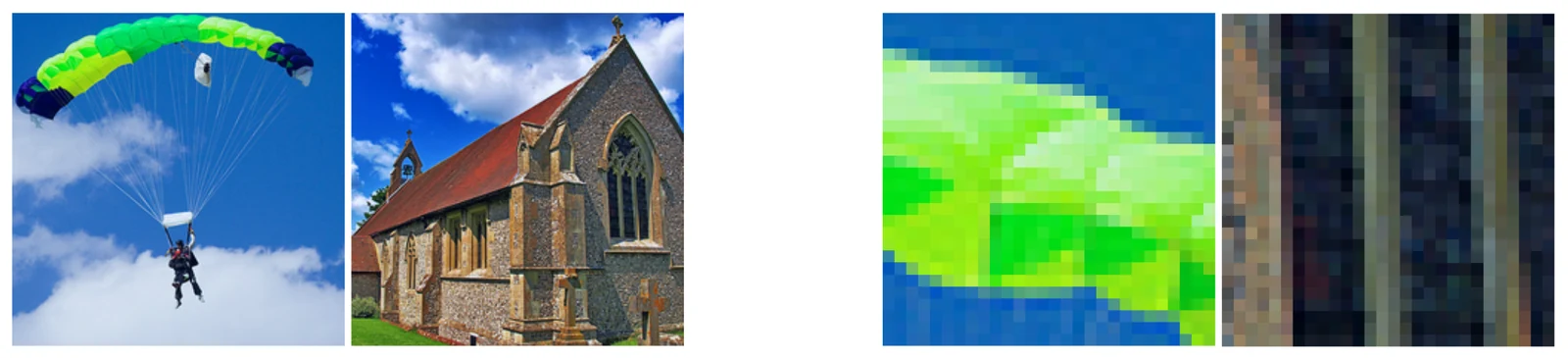
CVPR, 2022 output general-purpose embeddings, so there is no label signal to supervise extraction. - Crop-and-resize shifts the input. A ViT is trained on full images, so an upscaled low-resolution crop falls outside its training distribution, and global self-attention treats the crop as a whole scene (Figure 2).
- Pooling discards geometry. Factorizing pooled vectors loses where a concept is, so it has to be found again with gradient-based attribution.
Method
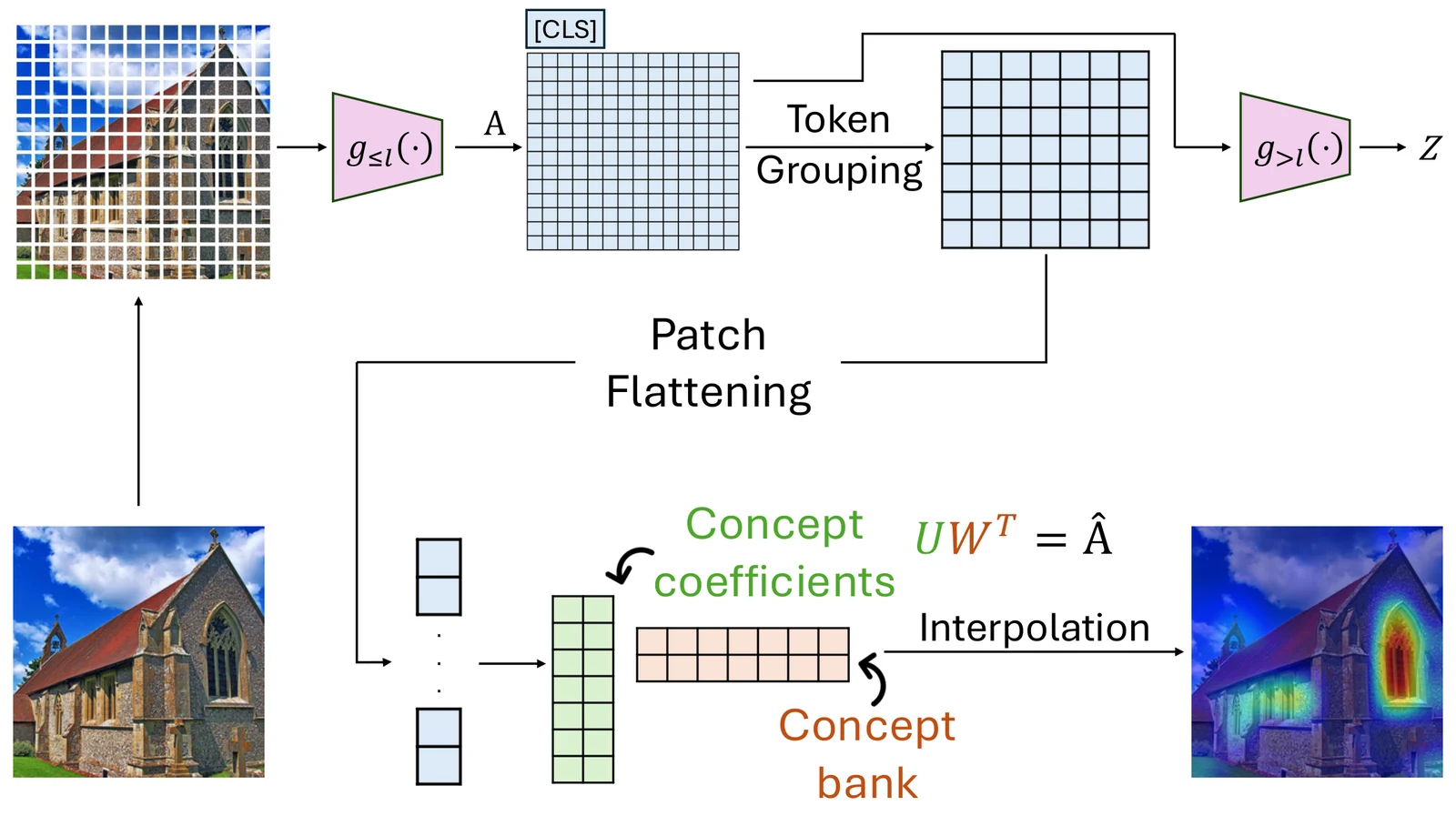
PLACE splits a frozen ViT at layer and takes the patch-token activations of a set of images, one row per token, as a matrix . It factorizes them with Semi-NMF6Convex and Semi-Nonnegative Matrix Factorizations
Chris H.Q. Ding, Tao Li, Michael I. Jordan
IEEE TPAMI, 2010 as : each column of the concept bank is a concept, and the non-negative coefficients say how much of each concept every patch holds.
Since a VFM has no classifier head, PLACE adds a Gram-matrix term that preserves the pairwise inner products among all tokens:
(1)
The paper proves that these two terms together bound the KL divergence of any linear classifier on top of the model. Optimizing them requires no labels and no forward or backward pass through the rest of the network. Each coefficient is tied to one patch, so a concept's heatmap is obtained by reshaping its coefficients onto the token grid and upsampling them.
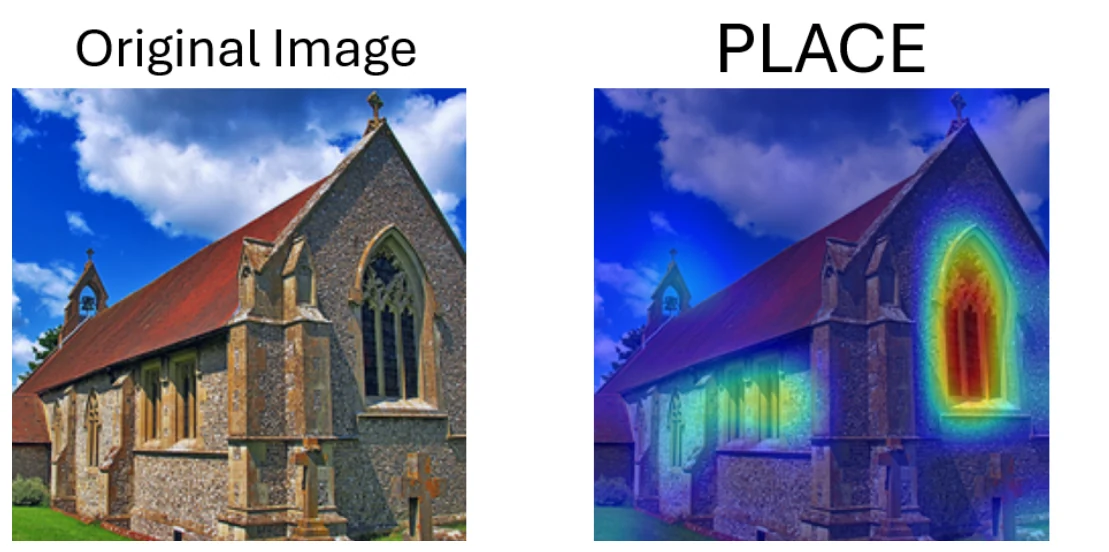
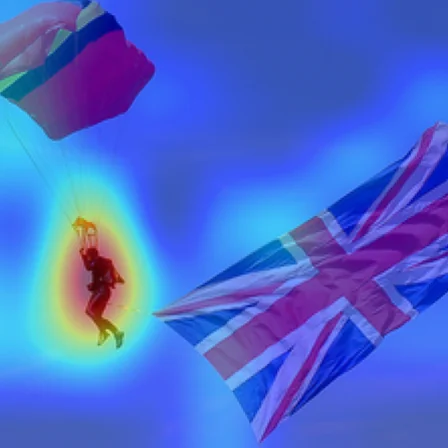
The objective uses no labels, so the factorization captures the composition of the whole scene, including the context around the labeled object. The top concepts often isolate people holding objects, backgrounds, skies, and terrain, as the concept explorer at the top of the page shows. Its heatmap is a concept's coefficients upsampled from the patch grid, and its Token PCA view projects the raw patch tokens to RGB.
Results
On ImageNet7ImageNet: A Large-Scale Hierarchical Image Database
Jia Deng et al.
CVPR, 2009,8ImageNet Large Scale Visual Recognition Challenge
Olga Russakovsky et al.
IJCV, 2015 and COCO9Microsoft COCO: Common Objects in Context
Tsung-Yi Lin et al.
ECCV, 2014, with DINOv2, ViT-MAE, and ViT-B/16 backbones, against sparse autoencoders (SAEs)10Sparse Autoencoders Find Highly Interpretable Features in Language Models
Robert Huben et al.
ICLR, 2024,11Sparse Autoencoders Learn Monosemantic Features in Vision-Language Models
Mateusz Pach et al.
NeurIPS, 2025:
- 20×
- faster than KL-supervised extraction: 5.6 s per class against 118 s.
- 11×
- faster than training a sparse autoencoder on the same activations.
- 0.933
- C-Gini sparsity, higher than both SAE variants in four of six configurations.
- 0.923
- mean matched cosine similarity to classifier-supervised concepts, on ViT-MAE.
Citation
@inproceedings{onorato2026place,
  title     = {{PLACE}: Patch-Level Agnostic Concept Extraction},
  author    = {Onorato, Gabriele and Silvestri, Fabrizio and Bastian, Nathaniel D. and Restuccia, Francesco},
  booktitle = {The Fortieth Annual Conference on Neural Information Processing Systems},
  year      = {2026},
  url       = {https://openreview.net/forum?id=8QlhKxCYSB}
}
Acknowledgements
This work was supported in part by U.S. National Science Foundation (NSF) under Grants CNS-2312875 and OAC-2530896, Defense Advanced Research Projects Agency (DARPA) under Cooperative Agreement D25AC00374-00, Office of Naval Research (ONR) under Award N00014-23-1-2221, and the Air Force Office of Scientific Research (AFOSR) under Award FA9550-23-1-0261.
References
- [1]Thomas Fel et al. CRAFT: Concept Recursive Activation FacTorization for Explainability. CVPR, 2023.
- [2]Dipkamal Bhusal et al. FACE: Faithful Automatic Concept Extraction. NeurIPS, 2025.
- [3]Alexey Dosovitskiy et al. An Image is Worth 16x16 Words: Transformers for Image Recognition at Scale. ICLR, 2021.
- [4]Maxime Oquab et al. DINOv2: Learning Robust Visual Features without Supervision. TMLR, 2024.
- [5]Kaiming He et al. Masked Autoencoders Are Scalable Vision Learners. CVPR, 2022.
- [6]Chris H.Q. Ding, Tao Li, Michael I. Jordan. Convex and Semi-Nonnegative Matrix Factorizations. IEEE TPAMI, 2010.
- [7]Jia Deng et al. ImageNet: A Large-Scale Hierarchical Image Database. CVPR, 2009.
- [8]Olga Russakovsky et al. ImageNet Large Scale Visual Recognition Challenge. IJCV, 2015.
- [9]Tsung-Yi Lin et al. Microsoft COCO: Common Objects in Context. ECCV, 2014.
- [10]Robert Huben et al. Sparse Autoencoders Find Highly Interpretable Features in Language Models. ICLR, 2024.
- [11]Mateusz Pach et al. Sparse Autoencoders Learn Monosemantic Features in Vision-Language Models. NeurIPS, 2025.
- [15]Neehar Kondapaneni, Oisin Mac Aodha, Pietro Perona. Representational Similarity via Interpretable Visual Concepts. ICLR, 2025.
Special thanks
We are grateful to the authors of CRAFT1CRAFT: Concept Recursive Activation FacTorization for Explainability
Thomas Fel et al.
CVPR, 2023, FACE2FACE: Faithful Automatic Concept Extraction
Dipkamal Bhusal et al.
NeurIPS, 2025, and RSVC15Representational Similarity via Interpretable Visual Concepts
Neehar Kondapaneni, Oisin Mac Aodha, Pietro Perona
ICLR, 2025 for releasing their code as open source.